On December 25th, we visited the Seven Star Crags National Park, located in the city of Zhaoqing.
Historical Background/Legend: The Seven Star Crags (qixingyan 七星岩)National Park consists of crags, rivers, lakes, and caves. The landmark is called “Seven Star Crags,” because the crags are geologically arranged in the same formation as the seven stars of the Big Dipper constellation (Crag: a steep or rugged cliff or rock face). The names of the “Seven Star Crags” are:
Out of all of the crags, 1 of them (“Heavenly Columns Crag,” 天竺岩) is the only one that can be climbed (See below)
The main Chinese legend is that the pillars of limestone (which the crags are made of) were created from stars that fell from the skies. The remaining pieces then formed caves and other precipices.
Recap: We took a “sub” high-speed train from Foshan to Zhaoqin. From there, we hopped on the first taxi that we saw, which took us to the West entrance of the Seven Star Crags National Park. After we purchased our tickets, we were paired with a very sanguine tour guide. The tour guide took us on a river boat “cruise” from the West entrance of the island to the Eastern part. Looking out the window, the view was spectacular. The majority of crags were visible, and most were connected by tiny bridges. These crags overlooked a dark green lake, fittingly known as “Star Lake.” While there was no sun outside (for the entire day actually), the foggy mist added an extra air of mystery to the setting.
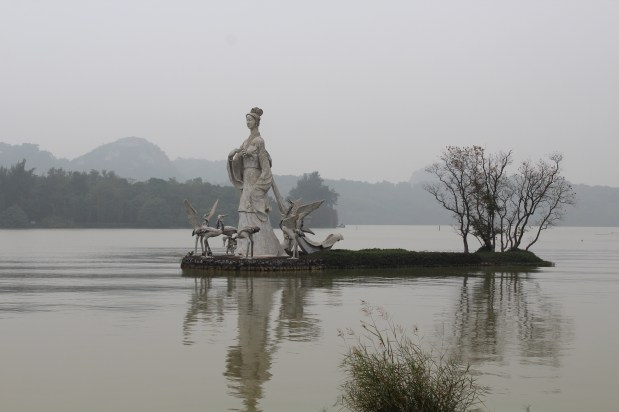
During the river tour, we also witnessed many sculptures of famous Buddhist and Taoist figures. While there were many, the most famous by far was the sculpture of the “Rice Flower Fairy Lady” (禾花仙奴). The tour guide explained that the purpose of the “Rice Flower Fairy Lady” was to provide enough food during a period when rice (the staple food) in the region was scarce.
When we reached the Eastern part, we visited a reserve for migratory birds. At first glance, this reserve didn’t seem like anything out of the ordinary, but more time revealed that it was definitely NOT a petting zoo. We saw two species of birds: The graceful Red Crown Crane, which were in the middle of their mating season, and the ravenous _______, which could quickly bite off your hand if you tried to feed/pet it.
After visiting the migratory bird reserve, we took a well-needed break to eat Dim Sum (dian xin 点心), before climbing the “Heavenly Columns” Crag (天竺岩).
Surprisingly, the climb to the top was not too difficult. There were steep stairs that projected from the sides of the mountain, which made the climb easier. Periodically, there were even scenic outlooks were visitors could take pictures of the vast scenery below. Once I reached the bottom however, I really started feeling my legs give way! 😛
As the Chinese saying (buxucixin 不须刺心) goes: it was a long day, but it was definitely worth it.


 The Other Side of the Earth